
Back to projects
SaaSVirtuoLab's own demo

CloudFlow · SaaS admin console

Demo: the admin console of a fictional SaaS product, with tabs for overview, customers, subscriptions, invoices and settings, filled with sample data.

Screenshot of the CloudFlow · SaaS admin console demo (SaaS), built by VirtuoLab

About CloudFlow · SaaS admin console

Type
VirtuoLab's own demo
Technologies
ReactNext.jsTypeScriptTailwind CSSSVG

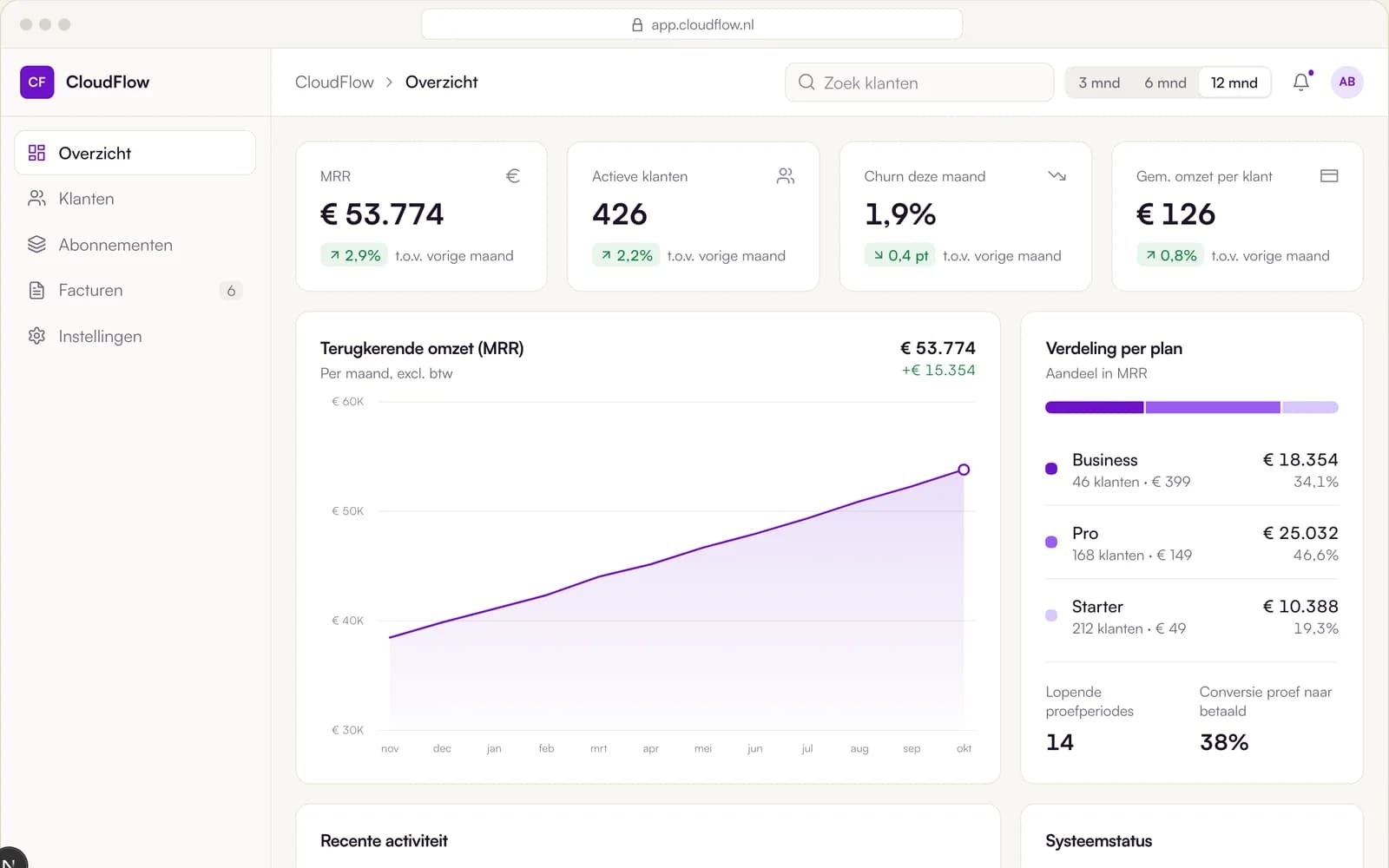
CloudFlow is a fictional SaaS product, and the CloudFlow demo shows the admin console designed by VirtuoLab for the product. The page is built with React, Next.js and TypeScript and runs in Dutch, English and German. Five tabs divide the work: Overview, Customers, Subscriptions, Invoices and Settings. First, the overview for October 2026 shows monthly recurring revenue (MRR) of €53,774, 426 active customers and churn of 1.9%, with an MRR chart over 3, 6 or 12 months. Second, a panel splits MRR across three plans: Business, Pro and Starter. The customer table is searchable and filters by plan, and invoices filter by status. Every company, amount and invoice in the demo is sample data. There is no real platform, customer base or API behind the CloudFlow screen.

SaaSAdmin consoleSubscriptions
01

What does the CloudFlow demo show?

The CloudFlow demo is the admin console of a fictional SaaS product, built by VirtuoLab with React, Next.js and TypeScript. A menu switches between five tabs. First, Overview shows four KPIs for October 2026: MRR of €53,774, 426 active customers, churn of 1.9% and average revenue per customer, each compared with the previous month. A chart shows MRR over 3, 6 or 12 months, and a panel splits customers across three plans: 46 on Business at €399, 168 on Pro at €149 and 212 on Starter at €49 per month. An activity feed, a system status block with incidents and a notification bell complete the overview. Second, Customers is a table with search by company, contact or city and a filter by plan. Third, Subscriptions shows the MRR movement for October, split into new, expansion, contraction and churned, plus recent upgrades and downgrades. Fourth, Invoices filters by paid, open and overdue. Finally, Settings holds company details, notifications and a team with three roles. The demo runs in Dutch, English and German, and every company and amount is sample data.


02

Which business problem does a SaaS dashboard like CloudFlow solve, and for whom?

A SaaS dashboard like CloudFlow is an internal overview of subscriptions, revenue and user activity, which otherwise sit in separate tools. Without a dashboard, a founder with Stripe, a database and a CRM opens three tools every morning and still lacks one clear picture. Founders of software start-ups, product owners and support teams use such a screen every day. The dashboard answers three daily questions in one view: (1) how many customers are active, (2) how much revenue comes in, and (3) which plans grow. A customer table with statuses such as past due and an activity feed with failed direct debits help support staff respond before a customer cancels. Additionally, churn and conversion figures show whether a pricing change works. In practice, the admin dashboard is often the first internal screen of a new SaaS platform, for example for a start-up with its first 100 users. At 500 customers, manual exports from Stripe and the CRM can easily cost hours every week.

03

How does VirtuoLab build a SaaS platform for a real business?

VirtuoLab builds a SaaS platform for a real business in four steps, starting with a small first version. The reason is risk: in an analysis by CB Insights of 431 companies, all VC-backed start-ups closed since 2023, poor product-market fit played a role in 43% of the cases with a known cause. Step 1 is a scope session about users, plans, billing and the one workflow customers pay for. Step 2 is design and validation, with clickable screens such as the CloudFlow admin console. Step 3 is building and testing in short sprints with interim demos, for example with Next.js, TypeScript, Node.js and PostgreSQL. In a real project, VirtuoLab connects the dashboard to the live database, a payment provider and a login system, so every figure is real. Finally, step 4 is launch and support. As an indication, a SaaS MVP starts at €15,000, and a complete SaaS platform costs €30,000 to €80,000. The exact price follows after a free introductory call.